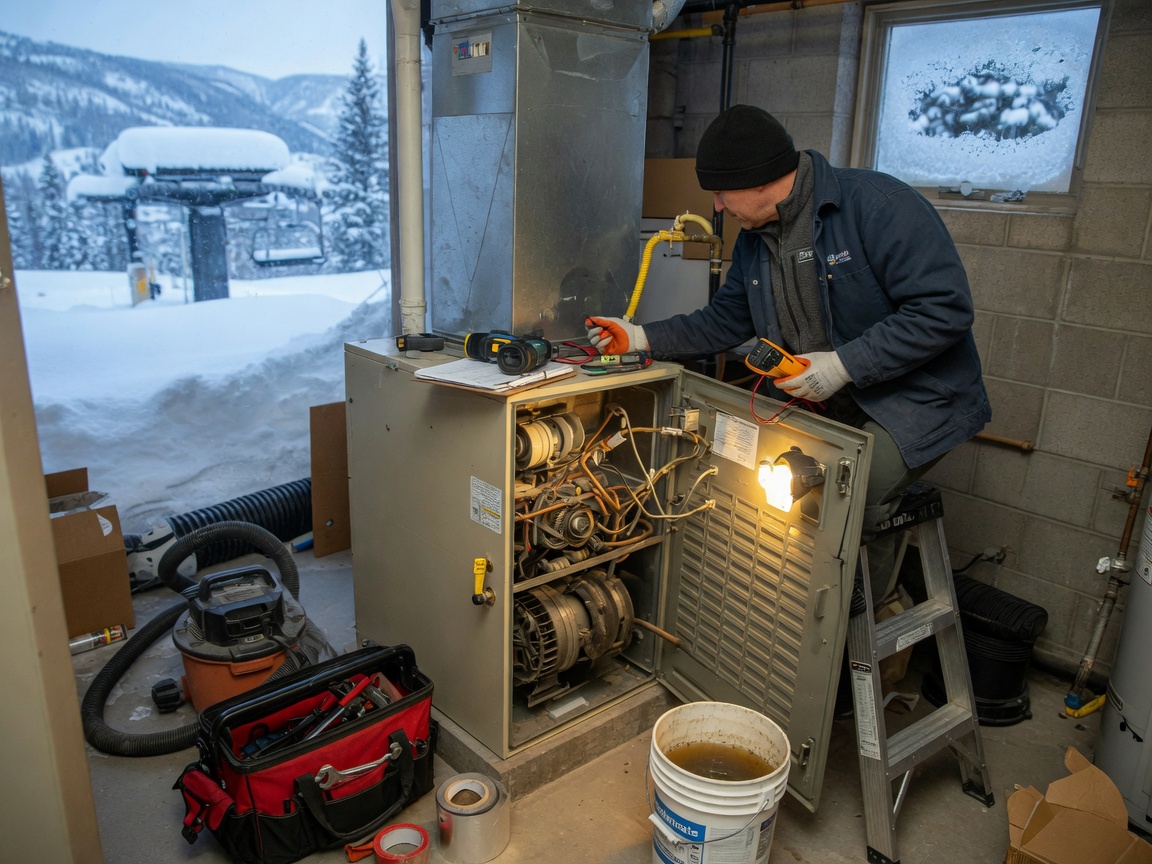
Vail homes often sit on older duct runs that collect fine glacial silt and wood-stove ash, restricting airflow and forcing the blower to work harder. During a maintenance visit we pull every accessible register, vacuum the main trunk lines with a HEPA unit, and check static pressure at the furnace to catch restrictions before they turn into no-heat calls on the coldest nights. We also inspect the condensate drain and secondary heat exchanger for corrosion that accelerates in the high-humidity air created by tightly sealed Alaskan envelopes.
Thermostats in Vail residences frequently sit on exterior walls or near wood stoves, giving false readings once outdoor temperatures drop below zero. We recalibrate or relocate sensors, verify anticipator settings on older mechanical models, and test the full sequence of operation including limit switches and rollout sensors that can stick after years of short cycling. Homeowners who skip this step commonly see their systems short-cycle right when the temperature bottoms out at night.
Snow load on rooftops can crush or block combustion-air intakes on high-efficiency units common in newer Vail builds. We clear and screen these openings, check inducer motor amperage under load, and confirm proper slope on PVC vents so melting snow does not refreeze and trap exhaust. This single check prevents the majority of mid-winter lockouts that otherwise require emergency service after a heavy snowfall.
Technician insight
In Vail the thing that catches most people out with Heating Maintenance is how quickly fine glacial silt migrates into return ducts during shoulder seasons, choking filters and raising static pressure long before the furnace fails on the first real cold snap.
Blocked Intake During Early Snow
A Vail homeowner noticed short cycling after the first heavy snow. We found the combustion-air intake partially crushed under roof snow load and the inducer struggling. We cleared and screened the vent, reset the pressure switch, and confirmed proper operation so the system stayed online through the rest of the cold spell.
Heating Maintenance Services We Offer
✓Filter Replacement and Duct Cleaning
Remove accumulated silt and ash from ducts and install high-efficiency filters rated for cold-climate systems to restore airflow.
✓Thermostat Calibration and Relocation
Adjust or move thermostats away from exterior walls and heat sources so the furnace runs on accurate temperature data.
✓Combustion Air and Vent Inspection
Clear snow-blocked intakes, verify vent slopes, and test inducer performance to prevent carbon-monoxide and lockout issues.
✓Blower Motor and Belt Service
Lubricate bearings, check belt tension, and measure amperage draw so the motor survives continuous winter operation.
✓Heat Exchanger and Limit Switch Check
Inspect for cracks and test safety switches that commonly fail after repeated short cycles in extreme cold.
Heating Maintenance Cost in Vail, AK
| Service | Typical Range | What Affects It |
|---|---|---|
| Annual Heating Maintenance | $225–$375 | Varies with system age, number of zones, and duct access in crawlspaces common in Vail. |
| Duct Cleaning Add-On | $150–$300 | Depends on home size and accumulated silt load from local terrain. |
| Thermostat Replacement | $120–$250 | Price changes with smart vs mechanical models and wall access. |
Ranges are typical for Vail, AK and confirmed with an exact written quote before any work starts.
How it works
- 1
System Assessment
We review runtime history, check for error codes, and note any prior repairs specific to Vail conditions.
- 2
Component Cleaning
Filters, burners, and accessible duct sections are cleaned of silt and combustion residue.
- 3
Safety and Performance Testing
Limit switches, rollout sensors, and combustion-air paths are verified under simulated load.
- 4
Documentation and Recommendations
Findings are logged with photos and any needed follow-up work is quoted before we leave.
Pricing
Upfront quotes are given after the initial inspection; no work begins without approval.