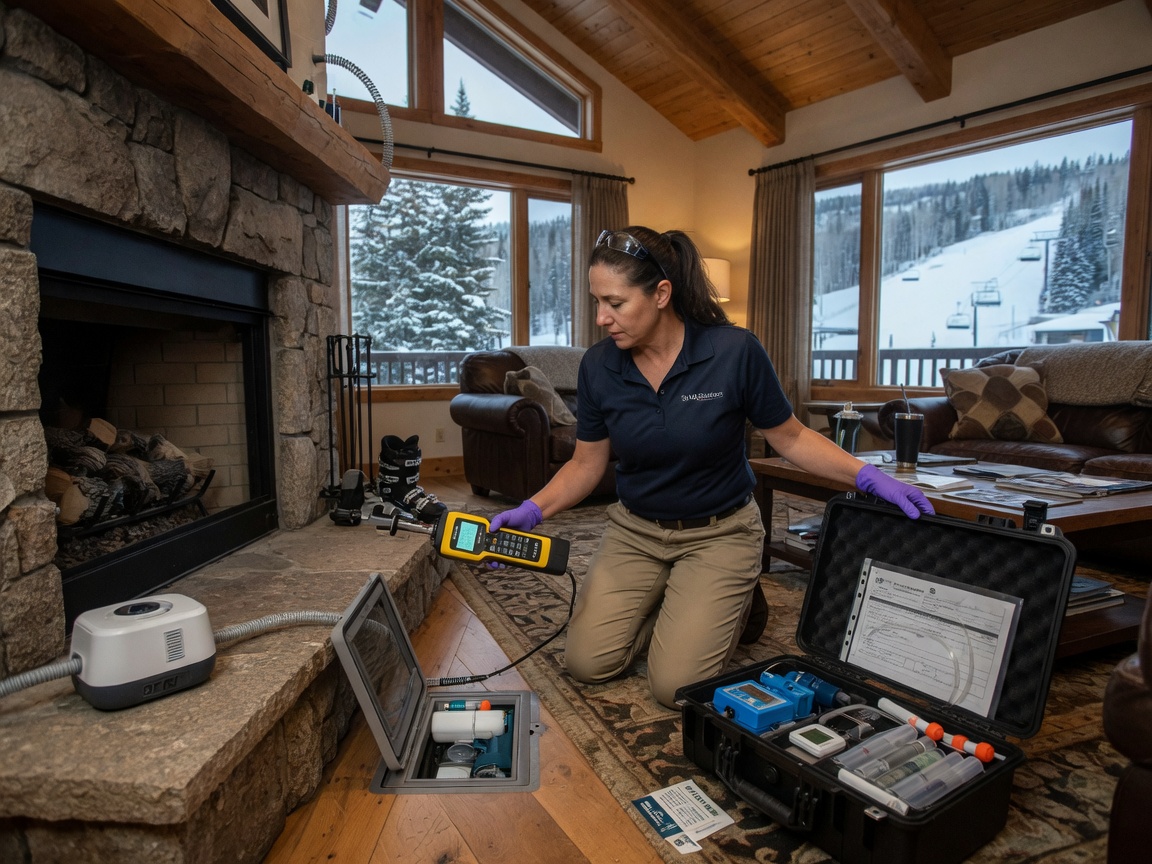
Vail homes often feature tight construction to retain heat during long winters, which traps combustion byproducts from furnaces and wood stoves. Testing focuses on carbon monoxide, nitrogen dioxide, and particulate matter that build up when exhaust systems underperform in subzero conditions. We sample in living spaces, utility rooms, and attics where duct leaks commonly pull in outside air mixed with snow-melt moisture.
Older housing stock around Vail frequently uses single-wall vents and older forced-air systems that corrode faster due to temperature swings and road-salt exposure on metal components. Our protocols check for backdrafting at each appliance and measure relative humidity levels that spike when homes are sealed against wind-driven snow. Results guide targeted sealing or ventilation upgrades without guessing at the source.
Soil conditions in the Vail area include permafrost pockets that shift foundations and crack crawlspace vapor barriers. This allows radon and microbial growth to enter living areas through slab edges and utility penetrations. Testing includes grab samples at multiple heights and locations to map how terrain-driven air movement affects pollutant distribution during shoulder seasons.
We document findings against Alaska residential energy codes that require mechanical ventilation in tightly built homes. Reports list exact contaminant levels and recommend fixes such as ERV adjustments or combustion-air intakes sized for local wind loads, giving homeowners clear next steps before issues affect furnace performance.
Technician insight
In Vail the thing that catches most people out with Indoor Air Quality Testing is how permafrost movement cracks crawlspace liners and lets radon ride the same air path the furnace uses for makeup air during January cold snaps.
Tighter Home After New Windows
Homeowners in Vail noticed headaches after installing new windows that reduced natural air leakage. Testing found elevated CO near the furnace during morning cycles. We located a partially blocked flue and added combustion air, restoring safe levels without replacing equipment.
Indoor Air Quality Testing Services We Offer
✓Combustion Byproduct Testing
Measures carbon monoxide and nitrogen dioxide levels near furnaces and water heaters to catch exhaust leaks common in Vail's cold-weather operation.
✓Mold and Moisture Assessment
Samples air and surfaces in attics and crawlspaces where snow melt and poor insulation create hidden growth that affects furnace filter life.
✓Radon Screening
Short-term radon tests in lower levels of Vail homes built on shifting permafrost soils that open pathways for soil gas entry.
✓Particulate Matter Monitoring
Tracks PM2.5 and PM10 from wood stoves and diesel equipment that infiltrate homes during inversion events in the Vail valley.
✓Ventilation System Evaluation
Checks HRV and ERV performance to ensure adequate fresh air exchange in tightly sealed Vail residences during extended cold snaps.
Indoor Air Quality Testing Cost in Vail, AK
| Service | Typical Range | What Affects It |
|---|---|---|
| Basic IAQ Panel | $250–$450 | CO, radon, and basic mold screen; price rises with multiple stories or crawlspace entry |
| Combustion Safety Test Add-On | $150–$300 | Includes spillage and draft testing on existing furnace |
| Full Particulate And VOC Panel | $400–$650 | Extra cost for inversion-season PM monitoring or wood-stove homes |
Ranges are typical for Vail, AK and confirmed with an exact written quote before any work starts.
How it works
- 1
Site Walkthrough
We inspect the furnace, ductwork, and exhaust paths while noting home age and recent weather impacts on Vail properties.
- 2
Sample Collection
Multiple air and surface samples are taken at breathing height and near appliances using calibrated equipment suited for subzero conditions.
- 3
Lab Analysis
Samples are sent for independent lab review focusing on combustion gases, microbes, and particulates typical in Alaska heating systems.
- 4
Report And Recommendations
Findings are explained on-site with prioritized fixes matched to local code requirements and winter operating realities.
Pricing
Most Vail homes fall in the mid-range of testing costs depending on number of samples and access challenges.